
Subject of the competition, general guidelines and recommendations
The subject of the competition is the spatial-program, urban-architectural design for the part of the block (narrower competition scope) of the central city zone, between Kralja Milana, Svetozara Markovića, Nemanjina and Kralja Milutina Streets, considering the subject block unit whole (wider competition scope).
In the area of about 0.7 ha, the narrower scope of the competition covers the northeastern part of the block and is bordered by the regulation of Svetozara Markovića, Kralja Milana, Kralja Milutina Streets and the internal road that passes through the middle of the block. It consists of cadastral plots no. 1027, 1030, 1031, 1032, 1033, 1034, 1035, 1036, 1037, 1038, 1040/1 CM Savski venac and part of c.p. 1044 CM Savski venac (internal road) as an alternative segment in the consideration of a narrower competition scope, intended for communication.
The narrower scope is the subject of the poll spatial-program design, while the wider scope of the competition, in the area of about 1.9 ha, represents a complete block unit including the National Bank of Serbia building which is to be retained as an inherited obligation, in its current state.
Participants are expected to, in accordance with the program and needs of the purpose, as well as development trends, function-, content, ambiance- and technology-wise organize spaces intended for residential and business facilities with accompanying free and green areas to optimally utilize the capacities and potentials of the location and form a rational and attractive urban-architectural design, appropriate given the significance of the subject position in the urban core.
Respecting the location context, the significance and representativeness of the buildings in the immediate and wider visible environment and the fact that this is a very valuable urban space, all interventions should be carefully analyzed to get the best possible solution that would improve the artistic and functional characteristics of the environment. The competition design should affirm modern tendencies in architecture, design of buildings and public urban spaces.
The subject location should be considered as a part of the central and already built, mostly ambientally formed zone of Belgrade with a significant cultural and historical heritage. It is extremely important to affirm the location position as part of the main city axis Kalemegdan - Terazije - Slavija. A significant potential of this area is its capacity in terms of providing views of the immediate and wider environment and especially those of the Temple of St. Sava.
On the other hand, the competition subject space is "unfinished", most of the existing physical structure represents a non-affirmative remnant of past times, without articulation, clearly defined morphology and character, especially in the part along Kralja Milana Street. With the new construction, it is necessary to affirm the location potentials, create a new relationship between housing and business and form a new micro-environment given the context, positional significance and cultural-historical value of the location.
Competition participants are also expected to establish a quality relationship with the existing buildings that are to be retained, in accordance with the contextual values of the location, through the urban-architectural design of the northeastern part of the block, including open spaces in the public use system, adequately positioned pedestrian and vehicle accesses. The proposed design and program solutions must be appropriate to the importance of the location spatial position in the context of the central Belgrade zone.
Although the total built area within the block is limited by the parameters given in the General Regulation Plan, it is directly dependent on the function and content offered by the competition design that should activate the potentials of this space.
Program elements
According to the Belgrade GRP, the block is located in the zone of mixed city centers within the Belgrade center zone (M1). Areas of mixed city centers are those in which the construction of facilities intended for commercial, business and residential facilities is planned, with the obligation of non-housing facilities on the ground floor.
The planned purpose includes as possible contents: multi-family housing, business, commercial contents (trade, catering, contents of culture, entertainment, sports ...), as well as public purpose facilities.
The proposal for the construction of a new physical structure within the narrower competition scope should be organized on the unique construction plot GP1, which is made up of c.p. no. 1027, 1031, 1034, 1035, 1036 and 1037 CM Savski venac, with total area about 0.37 ha.
Space should be viewed from the aspect of existing and planned use and real possibilities of new construction, including the position on existing higher-rise buildings (existing buildings on c.p. 1030, 1032, 1033 and 1038 CM Savski venac) in terms of the relationship between existing and new physical structure, wherein the building on c.p. 1030 is to be retained in its current state without changing the capacity, while the buildings on c.p. 1032, 1033 and 1038 can be kept in the existing construction capacities with the possibility of reconstruction, restoration, revitalization, as well as the capacity expansion by extending up to the maximum allowed cornice height.
CHARACTER AND CONTENTS OF NEW CONSTRUCTION
The new construction on GP1, with its position, which is primarily determined by orientation towards Kralja Milana Street, as a segment of the most important urban region Kalemegdan - Terazije - Slavija, implies a representative character in every sense, both in terms of design, aesthetic characteristics and establishing relationships with the environment through affirming the existing and implementing new ambient values, as well as in terms of structure, content category, technological solutions and sustainability in the spirit and with the characteristics of modern architecture.
As the continuity of construction is one of the basic features of the urban environment, it is necessary to preserve the mixed, i.e. residential-business-commercial character of the area. The disposition of these contents should be provided so that the residential contents are on the higher floors, and the business, commercial and service contents are on the ground floor and the first floor, with possible positioning of the commercial contents in a part of the first underground floor. The parking for newly planned construction should be provided for within the corresponding construction plot, in the underground garage, in accordance with the standards.
The construction on GP1 should be foreseen in accordance with the conditions and construction rules given in Chapter 4.3.4. Urban and parametric conditions and guidelines, and other guidelines and recommendations given within part 4. COMPETITION TASK, considering the criterion that the predominant vertical regulation of new construction is limited by the height level of the "Hilton" hotel which is 150.75 m above sea level.
ACCESSES/ENTRANCES
Accesses and entrances for all contents should be planned in accordance with the needs of the purpose, the concept of the proposed solution and the applicable regulations, norms and planning restrictions.
- Entrances for commercial and business facilities must be independent of the entrances to the residential parts of the building.
- Vehicle accesses to the complex, including the entrance/exit to the underground garage, should be provided exclusively from Svetozara Markovića and Kralja Milutina streets, so that the primary access is from Svetozara Markovića. Vehicle access to the plots from Kralja Milana Street is not allowed.
- Provide conditions for access and maneuvering of emergency vehicles, especially related to fire protection in accordance with the category of buildings and purposes, according to the regulations governing the field of fire protection.
- All accesses, as well as maneuvering and communication spaces, should provide conditions for unimpeded movement and access for persons with disabilities, children and the elderly in accordance with accessibility standards.
HOUSING FACILITIES
Housing, traditionally represented in this area, in accordance with the current status of the location in the city core, should be planned in the category of higher level housing, including apartment and luxury housing.
- The entrance, hall space should be sized and conceived in accordance with the character of a higher standard of living and the contents that this space implies, including the doorman "workplace".
- Plan vertical passageways in the form of stairs and the number of elevators adequate for the number of floors and the number of apartments on the floor served by the observed vertical hub. Size the vertical passageways according to the regulations and design them so that they continuously provide a connection between all floors, from the lowest garage floor to the last residential floor.
- The envisaged structure of apartments should include:
two-room apartments - about 15%
three-room apartments - about 35%
four-room apartments - about 35% and
five-room apartments - about 15%
with a two-room apartment covering an area of about 60 m2, a three-room apartment of about 100 m2, a four-room apartment of about 140 m2 and a five-room apartment an area of about 200 m2.
- On the last floor, only higher capacity apartments should be included - four-bedroom and five-bedroom apartments.
- The content of each apartment must include a terrace / loggia / balcony
- The design solution must provide a minimum of 280 cm clear height of the living space as well as highest rank installation systems and equipment.
COMMERCIAL AND BUSINESS FACILITIES
The disposition of purposes within the business-commercial segment of the planned construction can be planned in such a way that access to the entrances to special units is provided exclusively from the ground floor, with the unit itself being on two levels, and the vertical connection between levels provided within it, and that access to special units is possible both on the ground floor and on the first floor level, provided that entrances and communications related to commercial and business facilities must be independent of entrances and communications of residential facilities, in all segments.
In case of independent access to units at each level, it is desirable to provide conditions for the implementation of the most frequent contents of a wide range of public availability at the ground floor level: trade, catering, commercial and cultural contents, business and service contents of high frequency of use (banks), etc., and at the first floor level, the conditions for the implementation of contents with slightly lower frequency of use: commercial and business and service facilities that operate openly, but also by the scheduling system (hairdresser, dentist, etc.).
- The structure of the space of this zone of facilities should be formed as maximally flexible, divisible according to needs, with the possibility of providing all the necessary conditions and accompanying contents in accordance with the needs of a specific purpose not known in advance.
- It is desirable to provide primary access from the most frequent public pedestrian communications "from the street" and inside the block, since such a disposition raises the level of attractiveness and quality of space use and allows forming active microenvironments.
- The design solution must provide a minimum of 320 cm clear height of commercial and business space and the implementation of highest rank installation systems and equipment.
- Connect the ground floors of new buildings as much as possible with the surrounding space and existing facilities in the area.
- The commercial and business zone of the facilities should be conceived as representative and transparent in terms of ambient.
The specific purposes of the commercial and business segment of the new construction, as stated, are not defined in advance, except for the obligation to provide conditions for the implementation of a SPA center with gym, totaling about 300m2, which should have access from inside the block, from the ground floor level, provided that the total area can be organized within the ground floor and part of the first underground floor.
LANDSCAPING
- Unload the block interior from auxiliary buildings and, by arranging and greening the block interior space, envisage equipping it with urban furniture in accordance with the character of the ambiance and the concept of the proposed new construction solution.
- Allowing for the block position, which enables connections with the "Manjež" park complex and the Slavija Square piazzetta, as well as the potential of their interconnection, it is recommended to organize landscaping – of open spaces, pedestrian routes and green areas of the block, as open city public use space. It is desirable to plan passages that will enable communication and public use of the block interior space.
- Contents and design of the block landscaping are to be planned and conceived emphasizing the urban character of the space to which they belong.
- Design the landscaping in accordance with the guidelines given in chapter 4.3.8. Guidelines and recommendations for free and green areas.
PARKING
- The vehicles parking needs of the newly planned construction should be solved within the belonging construction plot, in the underground garage, primarily in the facilities zone.
- The maximum occupancy by the underground garage is 85% of the plot area. If the construction line of the underground garage goes beyond the building size, the upper garage slab elevation on flat terrain must be harmonized with the terrain elevation, backfilled with earth and landscaped.
- Design parking spaces in accordance with the guidelines given in chapter 4.3.7. Guidelines and recommendations for traffic areas.
Program requirements
Planned construction capacities
Overview of planned land uses within the competition scope
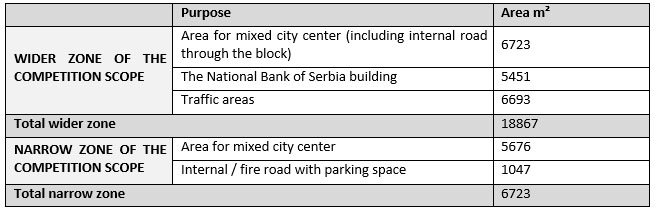
The planned construction capacities are determined by the urban and parametric conditions and construction rules given in Chapter 4.2.4. Urban and parametric conditions and guidelines.
Obligations in space formation
- Define the volumetry, basic elements of leveling and regulation (vertical and horizontal) and the character of the future construction of new block contents, respecting the given competition framework.
- All interventions should be aimed at preserving and improving the ambiance. The new construction should achieve an integrative relationship with the immediate environment, to emphasize the character of the environment by connecting with existing and ambient values on the one hand, and emphasizing the modern understanding of space, on the other hand.
- The specificity of the competition scope location makes the planned new construction participate in the remodeling of several city level significant thematically different micro-environments: along Kralja Milana Street is part of a representative street route from Resavska Street to Slavija Square, with orientation towards Slavija Square, along Kralja Milutina Street is the formative element of the Square, and with its orientation towards the Manjež Park, it is a segment of Svetozara Markovića Street that can be seen from great distances from the direction of Nemanjina Street. It is necessary to view all planned interventions in the context of the immediate and wider environment and through the analysis of all contextual influences, allowing for the specifics of micro-environments in whose affirmation the planned new construction participates, to reach appropriate design solutions.
- To harmonize the predominant height regulation of the new construction with the buildings of the immediate surroundings along Kralja Milana Street (the "Hilton" hotel building), to form a balanced height regulation of this area.
- Align the height regulation of new narrower competitive scope buildings with the height of neighboring existing buildings in the block not to be demolished, in terms of adequate height connection characteristic of the city zone, either considering the current height of existing buildings or planning their extension.
- The urban and architectural solution of the narrow competition scope should be formed in such a way as to "establish a relationship" with the existing NBS building in shape, as well as through horizontal and vertical regulation, allowing for the segment participating in the formation of Slavija Square as a visually prominent articulatory element.
- Vertical and horizontal regulation of future construction along Kralja Milana Street, as well as in the Slavija zone, must ensure the affirmation of the view of the Temple of Saint Sava.
- Define possibilities and models of interconnection of newly planned forms and buildings with the existing physical structure in the narrower competitive scope zone not to be demolished (by level, shape, ground floor treatment ...)
- The architectural and urban design and shaping of the building and space should be in the spirit and with the characteristics of modern architecture.
- Preserve the continuity of the existing formed street fronts.
- The primary requirements for the organization of space in the public use segment are the possibility of various uses, easy orientation, simplicity and efficiency of the organization of space intended for communications.
- Pedestrian areas as places of joint communication represent the most vital elements of the Slavija zone. The competition design should provide conditions for the maintenance and affirmation of this resource. In building the program concept, one should strive to provide a content structure on the street side that will continuously generate a typological, social and economic number of users adequate to the capacity and relevance of the location.
- Contents and design of the block landscaping should be planned and conceived emphasizing the urban character of landscaping, in terms of both design and contents.
- The traffic matrix from the valid planning documents, given in the competition documents, is a fixed competition design element. Vehicle access to the subject area is possible from Svetozara Markovića and Kralja Milutina streets. Vehicle access is not allowed from Kralja Milana Street.
- The proposed solution must not endanger the greenery within the limits of the wider competition scope and the possibilities of its improvement, which refers primarily to the tree lines along Kralja Milana, Svetozara Markovića, Kralja Milutina and Nemanjina streets.
- Enable the application of materials of adequate physical, functional and environmental characteristics, in accordance with the program and exploitation needs of the purpose and regulations in terms of highest level safety and infrastructure equipment.
- All accesses, maneuvering spaces and passageways should provide conditions for unimpeded movement for persons with disabilities, children and the elderly in accordance with accessibility standards.
Recommendations in space formation
- Affirmation of the quality of the monumental city area urban concept from Kalemegdan, through Terazije, to Slavija with an emphasis on the city ambiance urbanity.
- Fitting into a coordinated series of attractive spaces that maintain and affirm the whole of Slavija in the overall concept.
- Dynamics of physical structures and spatial articulation by the principles of "classical" blocks, organization of space that allows flexibility of contents and spatial coherence of diverse physical structures and functional integrity of different contents.
- Preservation of the urban street character, which is an integrative element in the Belgrade matrix.
- The urban organization of space should affirm the specificity of this part of the city at the macro and micro level.
- It is understood that all interventions on this area will be representative, have a unique character of individual segments harmonized with the whole.
- Strive to maintain the intensive and exciting character of Slavija in terms of visual characteristics and ways of functioning, which is manifested in the type and relationship of present contents, as well as in architectural characteristics, through dynamic relationships of physical structures, visual and shape contrasts, etc.
- The relationship between the regulation and construction lines, as a component of the space identity, in the current state of the subject space and the immediate environment, coincide and form blocks with the peripheral construction of clear horizontal articulation, which should be an important element for establishing continuity in interventions for new buildings. It is recommended to transform the narrower competition scope zone by planning the new construction of mutually built-in buildings on the regulation line and forming a compact block.
- Affirmation of macro and micro views.
Urban and parametric conditions and guidelines
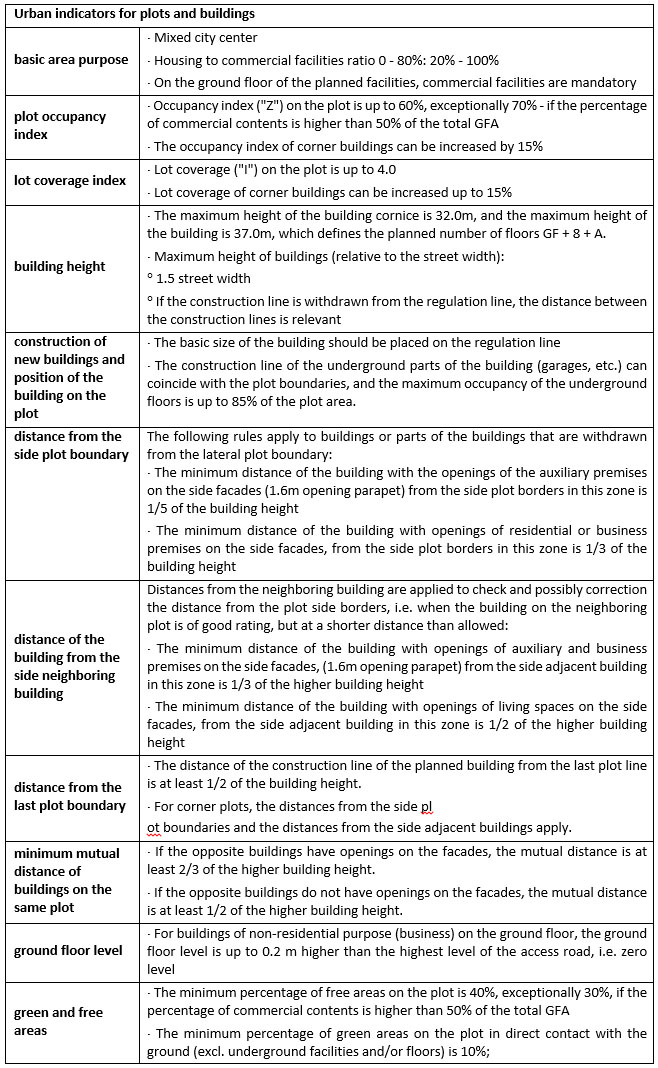
The stated urban parameters and guidelines are given according to the Belgrade GRP. The detailed spatial-program check, which is the subject of this competition, also aims to establish the level of urban parameters affirmative for the subject space. In that sense, the competition design needs to spatially review the capacities and construction rules envisaged by the GRP.
Any deviations from the GRP values in terms of greater than the maximum prescribed urban parameters or less than the minimum allowable distances, conditioned by the specific shape and proportions of the building or plot and construction in the immediate vicinity should be substantiated in the competition design.
Guidelines and recommendations for treating architectural and cultural heritage
The area of Slavija belongs to the area of general urban renewal, which implies the combined application of integrative conservation, urban renewal and spatial planning, harmonized according to the scope and value of the architectural heritage.
The subject block belongs to the zone of ambiance under construction with a recommendation for remediation of the existing condition with a larger scope of interventions (replacement of the construction body of poor rating, new construction of undeveloped space, interpolation, etc.)
From the aspect of protection of cultural goods and in accordance with the Law on Cultural Heritage ("Official Gazette of RS", No. 71/94), the area within the competition scope is not declared cultural property, is not within the spatial cultural-historical unit and is not within the preliminary protected unit. The letter of the Institute for the Protection of Cultural Monuments (number R20/21 of 20/01/2021) issued for the purposes of drafting a new detailed regulation plan, notes that part of the block is located within the "Zapadni Vračar" unit which was included in the record of property enjoying preliminary protection. "Having in mind that the protection measures on the subject unit in accordance with the provisions of the Law on Cultural Heritage were applied until December 25, 2020, we inform you that at this time it is not necessary to obtain conditions for technical protection measures on the subject area."
Within the block between Nemanjina, Svetozara Markovića, Kralja Milana and Kralja Milutina streets, there are no buildings of immediate interest for preservation, i.e. which would be obligatory to keep from the aspect of protection of cultural heritage.
Buildings at 43, 47 and 49 Svetozara Markovića Street represent a segment of the historical ambiance of Belgrade, valorized in the current DRP as ambient value and as such can be retained in the existing state of construction with the possibility of reconstruction, restoration, revitalization, as well as extension to the maximum height, primarily in plot interior to harmonize and connect the newly planned construction and existing facilities within the block.
Design guidelines and recommendations
The modern architectural expression in the design of new buildings is conditioned by respect for inherited values. A unique block design solution is recommended to avoid partial interventions that could disrupt the integrity and attractiveness of the street front. It is understood that all interventions on the subject block are representative, have a unique character, without unification. In terms of building shape, originality in the author's expression is mandatory. Special attention should be paid to exterior finishing materials.
The new physical structure should be formed as a part of a compact block which is connected by certain elements into a whole of high aesthetic values. It is necessary to apply concepts that are environmentally justified and energy-efficient.
All interventions on the site should be appropriate to its significance in the city structure. Careful planning and harmonization of the elements forming the volumetry of the entire block should strive for the most affirmative attitude towards the values of the environment. The multi-story buildings in Svetozara Markovića Street (GF + 7 + A) and Kralja Milutina Street (GF + 5 + A), as the existing spatial dominant of the block, should not be treated as a benchmark for planning future construction.
Considering that the area along Nemanjina Street has already been defined, without the possibility of intervention, the new construction in the remaining part of the block should strive to unify the height regulation of the block.
Guidelines and recommendations for traffic areas
Vehicle traffic
Vehicle access to the complex, including the underground garage entrance/exit, can be provided only from Svetozara Markovića and Kralja Milutina streets, at a minimum distance of 15 m from the intersection (measured from the regulation line of the cross street). When designing vehicle accesses from Kralja Milutina Street, allow for the existing taxi stand plan to be retained. Vehicle access to the plots from Kralja Milana Street is not allowed.
Vehicle accesses should be sized depending on the width of the accessing street, planned purposes and types of vehicles that will serve the contents (passenger, cargo / delivery, fire ...) so that the conditions of passability are met, i.e. that every vehicle can enter and exit with plots by going forward without additional maneuvering in the street zone.
In the situation of the expected application of the plot access control system, it is obligatory to provide an entrance part on the belonging plot, so that the vehicle waiting for access does not interfere with the functioning of traffic on the surrounding street network.
Vehicle parking needs for newly planned facilities should be addressed within the associated construction plot in the facility zone, in the underground garage.
The maximum occupancy of the underground garage is 85% of the plot area. If the construction line of the underground garage goes beyond the building size, the upper elevation of the garage slab on flat terrain must be harmonized with the terrain elevation, backfilled with earth and landscaped.
Plan the garage in several underground levels to meet the parking capacity needs of the planned construction and the norms. The garage space organization, in terms of the parking space size and maneuvering space relative to the parking angle, capacity and maximum distances of evacuation routes for users, should be designed in accordance with regulations, which includes:
- Clear height of the garage (counting from the floor to the lowest point of the installation elements) of at least 2.20 m;
- Right angle parking spaces (at an angle of 90˚) should be provided with size not less than 2.5 m x 5.0 m;
- For residential and residential-business buildings with more than 10 housing units, out of the total number of parking spaces, provide at least 5% of parking spaces for persons with disabilities of prescribed dimensions: for right angle parking at least 3.7 m x 4.8 m and 5.9 m x 5.0m for two connected parking spaces.
Entrances/exits of the underground garage should be provided in an adequate number and of adequate capacities in accordance with the regulations, which, among other things, means:
- for medium garages at least one two-way entrance/exit or two one-way (one entrance, one exit):
- for large garages, at least two two-way entrances/exits.
Overcoming height differences - entrance/exit to the garage and between the garage levels should be provided by ramps of slope, characteristics and capacity in accordance with regulations, which, among other things, means:
- that the car ramps for access to the garage are designed behind the sidewalk, i.e. behind the regulation line
- ramp inclination for passenger vehicles of maximum 12% for open or 15% for closed / heated ramps;
- ramp inclination for trucks maximum 9%;
- minimum width of the traffic lane in one direction at straight ramps for the movement of passenger vehicles of 2.75 m;
- widening of the traffic lane on curves in the case of roundabouts; - for garages where high interchangeability of vehicles is expected, the recommendation for the width of the one-way traffic lane is 3.0 m.
Parking standards
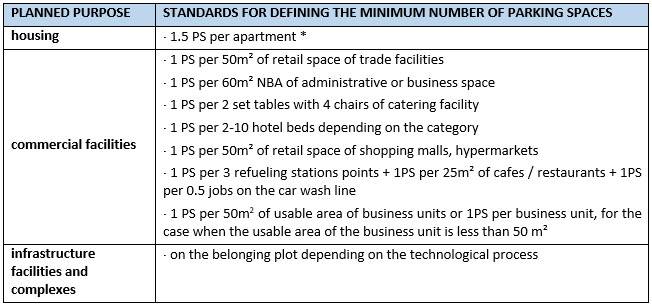
* Due to the location attractiveness, it is necessary to provide higher parking capacities than given on the basis of the GRP standards.
In the accompanying competition documents: III GUIDELINES OF COMPETENT INSTITUTIONS, complete Conditions of the Secretariat for Traffic of the City Administration of the City of Belgrade are enclosed
Pedestrian traffic
Given the attractiveness of the location and the planned facilities and capacities, intensive pedestrian flows are expected. Pedestrian areas (paths and sidewalks) are an integral element of the transverse profile of peripheral city roads.
In addition to the area along the traffic routes, pedestrian movements should be planned through the open and green areas of the block.
Design pedestrian areas in accordance with accessibility standards for unimpeded movement and access for people with disabilities, children and the elderly.
Guidelines and recommendations for free and green areas
Landscaping and arrangement should contribute to the identity of the new space along with the planned structure of the buildings. The green areas of the block landscaping should be planned so that they do not represent casual larger or smaller vacuums. Given the proximity of the Manjež Park, which represents a special value in a broader spatial sense, as well as the new Slavija Square piazzetta which give additional quality to space and purpose, it is purposeful to conceptualize the ground floor arrangement of the block in a way that provides continuous connection and inclusion of these areas as participants to the content and activities that can be organized in them.
Design and plan the block interior to become an integral organic part of the public landscape core, not a "green application." In that way, the complexity and multipurpose of this block is affirmed and qualitatively raised to a higher level.
- The minimum percentage of free areas on the plot is 40%, exceptionally 30%, if the percentage of commercial contents is higher than 50% of the total GFA
- The minimum percentage of green areas on the plot in direct contact with the ground (excl. underground facilities and/or floors) is 10%;
- Preserve the existing green areas and quality vegetation on the plot and emphasize the decorative character of green areas;
- Plan representative and purposely grown seedlings of high woody vegetation (deciduous and coniferous), leaf and flower decorative forms of deciduous and evergreen shrubs, seasonal flowers and grass areas;
- Plan 1-2% of terrain slope (covered surfaces) which enables normal drainage of surface water to the surrounding porous soil or storm drain, for which it is necessary to provide drainage elements (earthen gutters, canals);
- Arrange roof surfaces, of final and lower floors, if possible, as green roof terraces. If there are spatial conditions, the recommendation is to plant quality purposely grown hardwood seedlings in cassettes of 2.5 x 2.5 m indicative size. Greening of flat roofs of above-ground buildings should be on a minimum of 30 cm of soil substrate;
- If due to the underground floors it is not possible to form the required percentage of free soil for landscaping, the prescribed amount of greenery is to be compensated within the roof green areas, vertical landscaping and installation of decorative flower pots.
- Visually emphasize traffic communications and squares with greenery, tree lines and street lawns. Open spaces can be enriched with water surfaces (water mirrors, fountains, nozzles in the sidewalk). Materials for paths and plateaus and garden-architectural elements should be harmonized with the materials applied on the buildings.
In the accompanying competition documents: III GUIDELINES OF COMPETENT INSTITUTIONS, complete Conditions of JKP Zelenilo Belgrade are enclosed.
Infrastructure guidelines
Within the building, it is necessary to provide all standard rooms and spaces for the implementation of all installation systems that this type of building requires in accordance with the standard: water supply and drainage installations, electrical, telecommunications and signaling installations, heating, air conditioning and ventilation in accordance with regulations on technical safety, fire protection and environmental protection.
From the point of view of infrastructural equipment, it is possible for the subject contents to connect to the communal infrastructure (electric power, telecommunication, water supply, sewerage, hot water) in the necessary capacity.
Guidelines in relation to natural conditions
Since it is a built urban area, the natural conditions are less pronounced. However, an important characteristic of the subject area is the natural depression between the ridges in the center of Belgrade, which gives it the character of a natural center and thus predetermines the role of a traffic intersection and the confluence of a number of other streams.
The relief allows easy access from all sides, the engineering-geological characteristics do not set special restrictions for construction. The development of buidligs transversely against the isohypses is the most favorable from the aspect of engineering geology and parallel to the direction of basic wind currents.
The competition scope in the area of Kralja Milutina Street and, in part, Kralja Milana Street is directly exposed to the southeast wind, i.e. Košava that blows throughout the year (average speed from 25 to 45 km/ h, and storm surges up to 130 km / h). North and northwest winds are most pronounced in the winter, and the area of Svetozara Markovića Street is directly exposed to them.
When forming the spatial solution, it is necessary to provide favorable conditions of insolation by the position of the building, especially for residential purposes.
The primary criterion for determining the mutual position of buildings relative to insolation conditions is the length of the cast shadow. Insolation conditions are variable throughout the year and during the day. Starting from the fact that solar radiation is most needed and most pleasant in winter, around noon when the air is most transparent, it is concluded that as a measure of the distance between buildings, we should take the length of the shadow cast in the winter solstice, between 10 am and 2 pm.
As a criterion for the insolation distance between the opposite buildings, it is assumed that the residential premises have at least 2 hours of sunshine in the winter. It is necessary to allow for the insolation of free and green areas.